- About us
-
News & articles
Back
News & articles
View our latest company news and thought leaderships here.
See all the news stories - Products
- Underwriting teams
View our latest company news and thought leaderships here.
See all the news storiesThe next MPC interest rate decision falls on 30 April 2026. Where two to three cuts were expected across 2026, the base case is now a hold.
To view a PDF version, click here

The UK economy entered 2026 in a weakened state, though the picture has since been complicated by the latest ONS release. Monthly GDP grew 0.5% in February 2026, following growth of 0.1% in January, with construction itself contributing a 1.0% monthly increase1 . On the three-month basis – which is the more reliable indicator of trend – construction output fell 2.0% in the three months to February. The ONS is explicit that this data covers the period before the conflict in Iran began on 28 February, meaning it captures none of the shock that has since dominated conditions. The unemployment rate had climbed to 5.2% in the three months to January 2026 – its highest since the immediate post-Covid distortions – as wage growth decelerated from its post-pandemic peak. The Bank of England’s February Monetary Policy Report2 offered a cautious but navigable baseline that has since been overtaken by events.
On 28 February 2026, Israel and the United States began a campaign of military strikes against Iran, triggering an escalation that has closed the Strait of Hormuz to normal shipping and driven sharp increases in global oil and gas prices. As identified by the IMF in its April 2026 World Economic Outlook3 , the UK is structurally more exposed to energy price shocks than many of its G7 peers4 – as a net energy importer covering approximately 44% of its energy needs through imported sources – with particular dependence on natural gas for heating and power generation. Any dislocation in global gas markets feeds through rapidly into domestic inflation, business operating costs and household finances.
As of mid-April 2026, the Bank of England (BoE) has signalled that it is in no rush to raise rates but is closely monitoring developments, describing the conflict as a “very big energy shock” whose duration will be the critical factor. The IMF’s April 2026 World Economic Outlook revised UK GDP growth for 2026 down to 0.8%, with inflation forecast at 3.2%, reflecting the direct impact of the conflict on energy prices and supply chains. The OECD moved simultaneously, cutting its UK growth forecast from 1.2% to 0.7% while raising its inflation projection from 2.5% to 4.0%.
The inflationary backdrop was already testing before the conflict. Consumer prices including owner occupiers’ housing costs (CPIH) rose 3.2% in the 12 months to February 2026, unchanged from January, while CPI held at 3.0% - still well above the Bank’s 2.0% target. Core inflation – stripping out energy, food, alcohol and tobacco – ticked up 3.2% in February from 3.1% in January. Although trending lower, the nudge up is a reminder that underlying domestic inflationary pressures had not fully abated even before the energy shock arrived.
Prior to the Iran conflict, the trajectory had looked manageable: CPI was expected to fall to around 2.0% from April, partly supported by Ofgem’s new energy price cap. That path has now closed. In a March 2026 statement, the BoE said that CPI is now likely to be between 3.0% and 3.5% in the second and third quarters of 2026 as a direct consequence of higher energy prices5.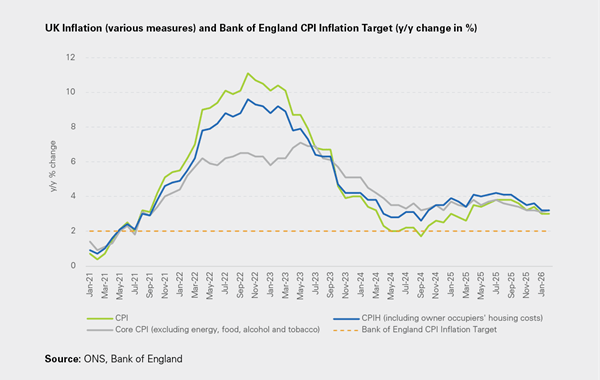
The Monetary Policy Committee voted unanimously to hold rates at 3.75% in Marc 2026, abandoning the expected cut as inflation reaccelerated. Money markets moved sharply in the aftermath of the conflict – traders were pricing in up to four quarter-point rate hikes by year-end at the peak of post-conflict-outbreak anxiety. As of mid-April, with a brief ceasefire providing some relief, market expectations have partially retraced – but the trajectory is materially worse than where expectations stood at the start of the year. Where two to three cuts were expected across 2026 before the conflict broke, the base case is now a hold at 3.75% for the remainder of the year, with upside risk to rates if the conflict proves protracted. The specific channels through which this shift feeds into construction activity are examined in the section below.
The channels through which the Middle East conflict affects UK construction are more numerous than the headline energy price data suggests. They fall broadly into three categories: direct input cost inflation, financial market tightening, and what might be called decision paralysis among investors and project sponsors.
Energy is a significant direct cost for construction companies – powering plant, machinery, site facilities and transport logistics. Beyond energy itself, construction’s material inputs are heavily energy-intensive to produce: cement, bricks, steel, aluminium and glass all require substantial energy to manufacture, meaning that sustained energy price elevation feeds through into the cost of primary materials with a lag of weeks to months.
The March 2026 PMI data confirmed that this transmission is already underway. The S&P Global/CIPS Construction PMI input prices index rose to 70.56 from 59.5 in February – the highest since November 2022, at the tail-end of the Ukraine-driven commodity spike, and the largest monthly acceleration since the survey began in 1997. Supplier delivery times lengthened for the first time since July 2025, reflecting disruption to established maritime supply routes, and companies widely cited rising fuel costs, higher transportation charges and raw material price increases in their survey responses.
Higher inflation expectations have driven up UK gilt yields and corporate borrowing costs. For construction, two transmission routes matter most. First, developer and contractor borrowing: the effective rate on new loans to UK private non-financial corporations had fallen from a 2024 peak of 7.26% to around 5.66% by February 2026 – a partial reprieve that had been baked into project financial models. That reprieve has now been eroded, effectively reversing months of gradual easing in a matter of weeks.
Second, and more immediately visible, mortgage rates on two year fixed deals have risen materially since the conflict began, adding to affordability pressures already evident before late February. For housebuilders – whose business model depends on both consumer mortgage affordability and developer debt financing – this is a double compression: demand weakens at precisely the moment that the cost of carrying inventory increases. Mortgage approvals in February 2026 stood at 62,584, already down from 65,114 a year earlier. Some development projects are being assessed as financially unviable at current rates.
The third, and arguably most consequential, channel for medium term activity is the ‘decision paralysis’ effect. Large-scale commercial, infrastructure and mixed-use projects typically require multi-year financing arrangements and depend on a stable outlook for both capital costs and demand. Geopolitical uncertainty – particularly when it raises the prospect of sustained energy price volatility – creates a rational incentive for investors, pension funds, insurers and project sponsors to defer major capital allocation decisions.
This dynamic was already evident before the conflict. Large contractors had been deferring the conversion of approved projects into starts, awaiting domestic policy clarity on planning reform and building safety regulation. The conflict has compounded that hesitancy into something closer to a systemic pause. The Glenigan Index7 for Q1 2026 illustrates the scale of the deterioration: the overall index is down 10.3% q/q. In March 2026, residential construction starts were 29.8% below the same month last year and civil engineering starts 33.5% lower, while only non-residential starts in positive territory at 4.9% above March 2025 – and that uptick largely reflects a single major London office development rather than any broadening of conditions. The conversion of a strong approvals pipeline into actual starts requires a degree of confidence that currently appears absent.
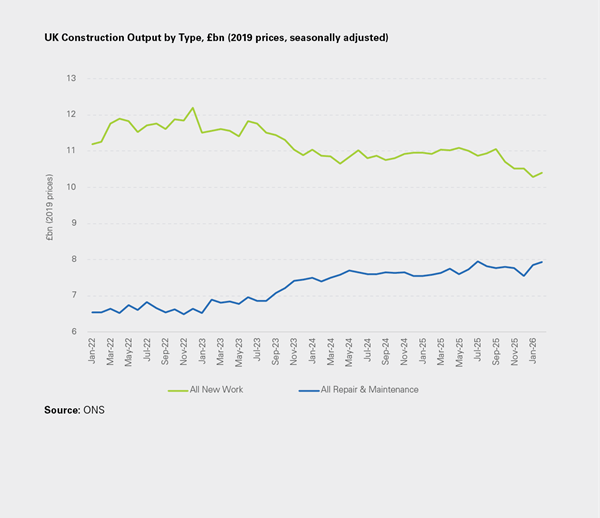
UK construction output grew 1.8% in 2025 compared to 2024 in headline terms, but this figure conceals a sharply deteriorating trend through the year. Q4 2025 saw total output contract 2.1% q/q, driven by a 2.6% decline in new work, and the weakness continued into 2026. The three-month measure to February fell 2.0%8- the fifth consecutive decline in this series. New work fell 3.4% over the period, while repair and maintenance showed no growth, with private new housing the principal drag, falling 6.5% over the three months across six of nine contracting sectors.
The forward pipeline tells a similarly deflating story. New orders had shown genuine promise through mid-2025 – all new construction work recorded 30.5% y/y growth in Q3 2025, followed by 28.6% in Q4, a meaningful shift after sustained contractions. But the headline figures mask a deteriorating trend: Q4 2025 saw total new orders fall 3.8% q/q driven by retreating private commercial and industrial work, suggesting that the Q3 surge partly reflected a clearing of deferred decisions rather than a durable re-acceleration.
The March 2026 PMI confirmed the deterioration, with new orders declining at their fastest pace since November 20259 as client risk aversion and delayed investment decisions – directly attributed to geopolitical uncertainty in survey responses – took hold. The pipeline had begun to soften on its own; the conflict has since amplified and entrenched that softening. The Construction Products Association (CPA) had already revised its 2026 output growth forecast from 2.8% to 1.7% in its Winter 2026 forecasts10 – before the Iran conflict broke.
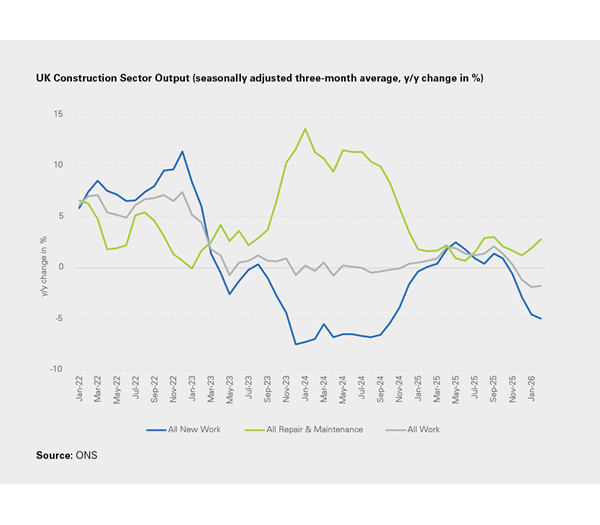
Infrastructure is the clearest positive outlier. The energy sector is driving genuine activity: grid upgrade programmes, offshore wind and renewables projects, nuclear investment, and the mandated quadrupling of water infrastructure investment over the next five years all represent durable demand that is less rate-sensitive and less confidence-dependent than commercial or residential work. Near-term starts data remains weak even in this sub-sector, but the underlying commitment of public and regulated capital provides a floor that residential and commercial work currently lacks.
Industrial and logistics construction had an exceptionally strong 2025, driven by e-commerce warehousing demand and the broader reshoring of manufacturing capacity. The £4bn gigafactory expansion in Somerset11added further momentum, reflecting sustained investment in domestic EV manufacturing capacity. Within non-residential work, London office development stands out as a pocket of resilience – starts rose more than two thirds in March 2026 according to the Glenigan Index, though this largely reflects a single major development at 105 Old Broad Street.
Residential construction is in its most sustained downturn in years, and the Iran conflict has made the outlook materially worse. According to the Glenigan Index of Construction Starts, residential starts fell 29.8% y/y in March 2026. The PMI housing sub-index stood at just 38.2 in March 2026 – by far the weakest of the three main sub-sectors.
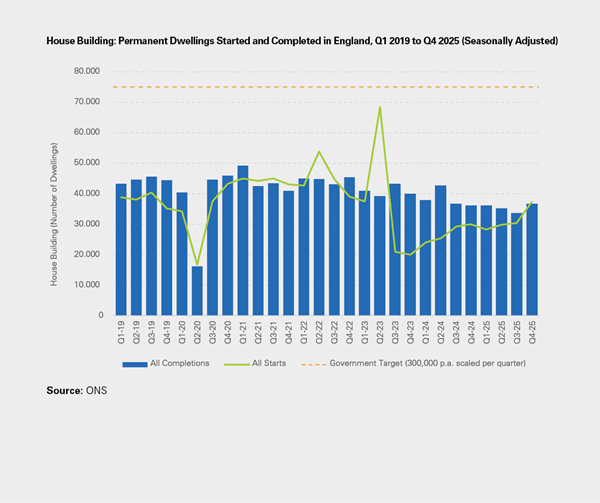
The government’s target of 1.5mn new homes in this parliamentary term was always ambitious; the combination of Gateway 2 safety regulations, chronic planning bottlenecks (average decision time has risen from 181 days in 2011 to over 300 days in 202512), a renewed financing squeeze from rising mortgage rates, and now investor risk aversion driven by geopolitical uncertainty makes it more remote than ever. The planning system has compounded these pressures – examined in detail in the Policy section below.
Commercial construction reflects the ongoing suppression of office demand from hybrid working, combined with weak consumer spending and the prospect of higher borrowing costs deferring investment. Building materials suppliers have felt this acutely: sales fell to a five-year low in early 2026, with some cement suppliers reporting volumes at multi-decade lows.
One of the sector’s few genuine improvements heading into 2026 was the normalisation of input cost inflation. Construction material prices had dipped into mild deflation in mid-2023 following the 2022 peak. Output price inflation, running at 2.7% y/y in September 2025 (the latest available ONS data13 had, for the first time in several years, exceeded input price inflation, providing some relief to margins that had been compressed for years. At the 2022 peak, input price inflation reached around 25% y/y while output price inflation peaked at 12% - a gap of 13 percentage points that eroded sector balance sheets over an extended period and from which many firms had not fully recovered before the current shock arrived. That supportive dynamic is now at serious risk of reversal
As set out in the Channel 1 transmission analysis above, this cost environment is a direct amplifier of credit risk for firms operating on fixed-price contracts.
In absolute terms, the context is sobering. The ‘all work’ construction price index stood at approximately 151.8 in early 2025, 37.3% above its 2020 level of 110.6. A second inflationary episode, even a less severe one than 2022, risks locking in a structurally higher cost base that prices out marginal projects and further compresses already thin margins.
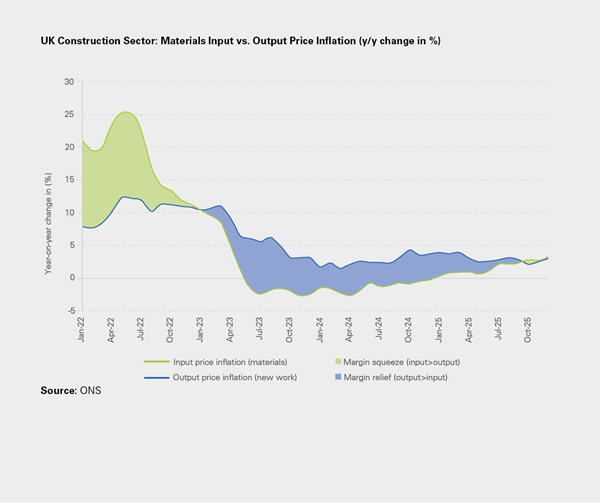
Note: The shaded areas illustrate the relationship between input and output price inflation. Where input inflation exceeds output inflation (margin squeeze, shaded red), construction firms are absorbing cost increases they cannot fully pass on to clients. Where output inflation exceeds input inflation (margin relief, shaded blue), firms have greater capacity to recover costs through pricing.
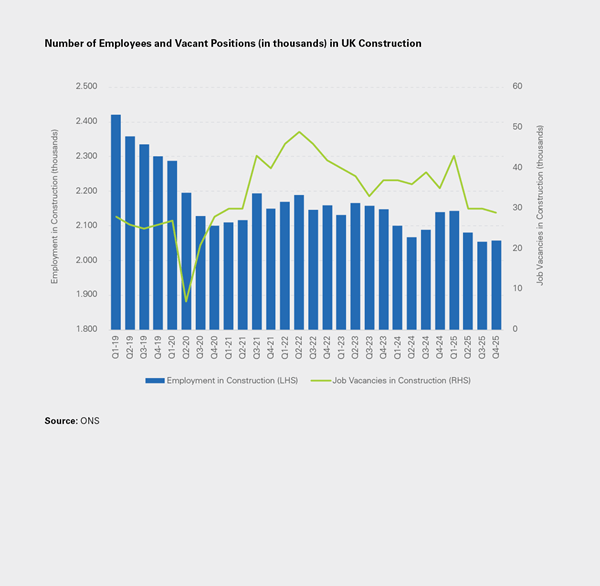
Across 2025, an average of 2,070,035 people were working in construction14 – a 0.9% decrease on the 2024 average and a 13.0% decline compared with the 2,379,276 workers employed in 2005, prior to the global financial crisis. The sector has shed workforce at a time when national employment has grown, a structural divergence that reflects not just cyclical conditions but the industry’s persistent difficulty attracting and retaining talent.
In the three months to January 2026, there were around 28,000 job vacancies in construction15, down 32.4% y/y, the largest percentage decline of any sector in the UK economy over the same period, and well below the approximately 45,000 vacancies at the 2022 peak. The vacancy ratio stands at 1.8 per 100 filled positions, against a UK average of 2.3. The falling vacancy count partly reflects subdued activity levels, but does nothing to resolve the underlying skills deficit. Specialist shortages remain particularly acute – scaffolders16, welders, mechanical and electrical engineers represent skills that the infrastructure buildout demands most, but which the sector has been unable to retain.
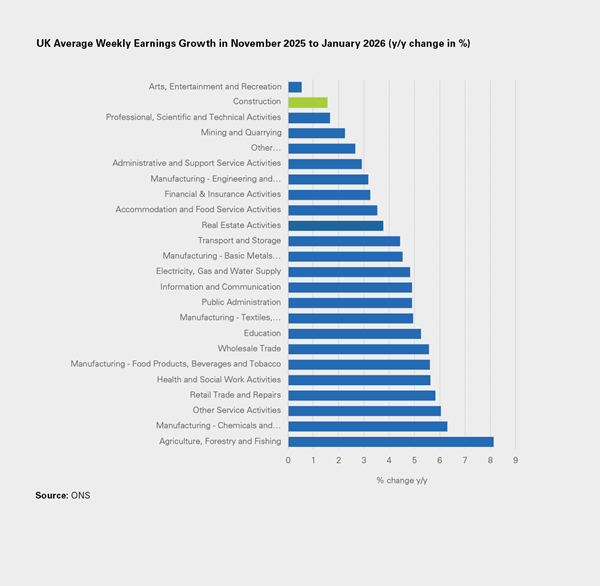
The wage picture has shifted significantly since the December 2025 report. Construction wages increased by just 0.1% in the year to January 202617, down from 2.4% in the twelve months to December 2025 and a fraction of the 5.7% recorded to September 2025. In the three months to January 2026, construction recorded the lowest regular earnings growth of any sector (other than the arts) at 1.6%, against a whole economy average of 3.4% - the ninth consecutive month in which construction’s annual wage increase has lagged the broader economy.
This deceleration is a double-edged development. It provides some relief to construction firms’ cost base at a moment when input prices are surging from the energy shock – but it also signals a sector in which workers are losing pricing power, which over time risks further eroding the labour supply pipeline precisely when the infrastructure buildout demands it most.
Construction’s credit risk profile remains the most elevated of any sector in the UK economy. In the twelve months to February 2026, the sector recorded 3,851 insolvencies in England and Wales18 – 17% of all cases where an industry classification was recorded, the highest share of any sector, despite accounting for approximately 6-7% of gross value added.
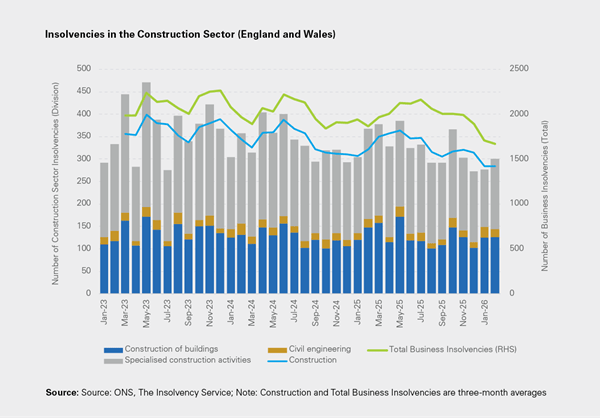
There are some genuinely encouraging signals. The rolling 12-month total of 3,851 represents a 4.9% decline on the 4,050 recorded in the year to February 2025. Full-year 2025 saw 3,945 failures – a reduction on 2023’s peak, though still 22.5% above the pre-pandemic 2019 level of 3,221. Monthly data for early 2026 showed insolvencies running below the 2022-25 average.
However, the structural vulnerabilities that have kept construction at the top of the insolvency table have not been resolved – and the new energy shock now risks reversing the modest progress of the past twelve months. The pattern of insolvencies is disproportionately concentrated in specialist sub-contractors: firms providing demolition, site preparation, electrical, plumbing, plastering and finishing work consistently account for the largest share19. These firms carry the thinnest margins, the least contractual protection against cost escalation, and the most fragile capital positions.
The EY-Parthenon’s quarterly UK Profit Warnings Report20 provides a corroborating perspective. FTSE-listed construction and materials firms issued more than three times as many profit warnings in 2025 as in 2024 – a significant deterioration, and all the more concerning because large contractors should theoretically be better placed to absorb shocks than smaller firms. Companies cited residential market weakness, commercial uncertainty, budget constraints and Gateway 2 delays as the principal drivers. Delayed or cancelled orders featured in 33% of profit warnings; weaker consumer confidence or rising costs in 11%. Looking into Q1 2026, the EY-Parthenon update indicates that uncertainty, geopolitical change and policy volatility continue to dominate.
Payment behaviour is deteriorating. Anecdotal evidence from across the supply chain points to creditors becoming less willing to absorb payment delays, with informal pressure giving way more quickly to formal enforcement action – including County Court Judgements and winding-up petitions. This is a pattern that historically precedes an uptick in formal insolvencies and signals a breakdown in the commercial trust that normally lubricates construction supply chains.
The Begbies Traynor Red Flag Alert for Q3 2025 showed that the number of construction companies in ‘significant financial distress’ had risen sharply year-on-year, with almost 104,000 firms affected – more than any other sector. The Q4 2025 update21, published in January 2026, confirmed that conditions continued to deteriorate: critical financial distress across the whole economy rose a further 21.3% in the quarter to 67,369 companies as of 31 December 2025, with all 22 sectors monitored recording a year-on-year deterioration.
Previous insolvency peaks in the sector have followed precisely this kind of escalation in financial stress – the 2022-23 wave was preceded by a similar pattern following the Russia-Ukraine commodity shock. The industry is watching the current geopolitical position closely, as a material deterioration in the input cost environment could render fixed-price contracts unviable for a significant cohort of firms.
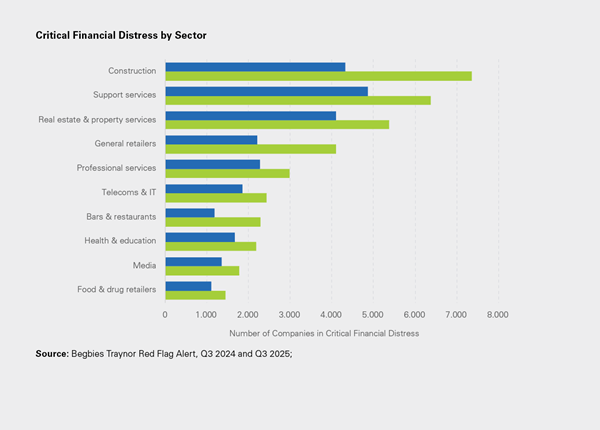
Note: Q3 2025 figures for sectors other than Construction are estimated by applying reported y/y growth rates to Q3 2024 base figures. Critical financial distress defined as companies identified by Red Flag Alert’s proprietary scoring system as facing a high risk of failure.
The government’s stated ambitions for construction – 1.5mn new homes in this Parliament, £725bn in infrastructure investment over ten years, a revamped planning system, and legally binding net zero decarbonisation – remain formally intact. What has changed is the environment in which those ambitions must be delivered.
The planning system remains the most immediate structural constraint on residential construction. Planning permission was granted for just 209,781 new homes in the year to September 2025 – the lowest 12-month total since 2013 – with just 1,311 sites approved in Q3 2025, fewer than at the depths of the global financial crisis. No more recent unit-level data is available. While planning applications rose to a decade high in 2025 according to TerraQuest’s Planning Application Index22 , the conversion rate from application to permission granted remains the fundamental constraint on delivery.
On completions, Q4 2025 saw 36,720 house building completions in England, an 8.9% increase on the previous quarter and 1.4% above Q4 202423. Starts in Q4 2025 reached 37,300, up 23.0% on Q3, with MHCLG attributing part of the increase to reforms at the Building Safety Regulator easing the Gateway 2 backlog. On the demand side, mortgage approvals in February 2026 stood at 62,58424, down from 65,114 a year earlier.
The Building Safety Act and Gateway 2 – both regulatory responses to the Grenfell Tower fire – continue to add administrative burden and timeline risk to residential development projects, particularly those involving higher-risk buildings. The Building Safety Regulator became an independent statutory body on 27 January 2026, triggering a new wave of adjustment to building control processes, competence standards and product regulation. For firms involved in higher-risk building work, this adds operational complexity and compliance cost at a moment when management bandwidth and financial resources are both stretched.
The government’s 10-year Infrastructure Strategy – committing £725bn over a decade to energy, water, rail, roads and social infrastructure – provides a durable source of demand that is less sensitive to the current confidence shock than residential or commercial work. Water companies are mandated to quadruple infrastructure investment over the next five years, including nine new reservoirs, and grid upgrade programmes represent contractually committed work. The Lower Thames Crossing has gained momentum following the reassessment of transport priorities post-HS2 cancellation.
Government finances were already constrained before the Iran conflict, and the energy shock introduces new pressures: higher inflation feeds through into welfare and pension costs, while weaker growth reduces tax receipts. The risk of further tax increases – including employer national insurance, business rates, corporation tax – cannot be dismissed. Construction companies operating on thin margins have limited capacity to absorb additional fiscal drag. The broader business cost environment, already cited as a material pressure on supply chain cashflow, risks further deterioration.
UK construction enters Q2 2026 with a genuine long term workload – an infrastructure pipeline, a structural housing deficit, ageing stock needing renovation, and legally binding decarbonisation commitments – but faces conditions in which doing that work has become genuinely harder than it was six months ago. The Iran conflict has not created UK construction’s structural problems, but it has arrived at the worst possible moment, deepening existing vulnerabilities and deferring what looked, in late 2025, like a credible recovery trajectory.
Our base case is that H1 2026 will represent the most challenging period for the sector since the immediate post-Autumn Budget slump of late 2024. The input cost shock is working through fixed-price contract portfolios at a moment when the mild downtrend in insolvencies looked set to consolidate – that progress is now at risk of reversal. The two-speed character of the market will persist and possibly sharpen: energy, water and infrastructure work will continue to provide a floor, while residential, commercial and repair and maintenance activity remain under pressure
Scenario A: Prolonged Conflict (Extended Squeeze) If the conflict is protracted, the risks are more severe. Sustained energy price elevation would transmit into a second wave of building materials inflation, likely triggering a new insolvency cycle concentrated among fixed-price contractors in specialist trades. The interest rate path would remain inverted from market expectations at the start of the year, compressing housing market activity into 2027 and jeopardising the financial viability of a growing share of development schemes. The CPA’s revised 1.7% output forecast would likely prove optimistic. Credit risk management in construction lending and trade credit insurance would need to adjust to a higher and more persistent risk environment.
The key indicator is whether the March 2026 CPI reading, due imminently, shows energy pass-through into core inflation – if it does, the rate hike scenario moves from tail risk to base case.
Scenario B: Conflict De-escalation (H2 Recovery) If the Middle East conflict de-escalates and the Strait of Hormuz reopens to normal traffic within the next two to three months, the energy price shock could partly unwind. The Bank of England may be able to resume a cautious rate-cutting cycle in H2 2026, consumer confidence could recover from current depressed levels, and the backlog of deferred projects could begin converting to actual starts. Private housing, in particular, would benefit disproportionately from a rate reduction, given its extreme sensitivity to mortgage affordability. Overall 2026 output would likely fall short of the CPA’s pre-conflict 2.8% forecast but could land in the 1.5%-2.0% range.
The key trigger to watch is whether the Strait of Hormuz reopens to commercial traffic ahead of the 30 April MPC meeting – if it does, a June rate cut becomes plausible.
References
[1] https://www.ons.gov.uk/economy/grossdomesticproductgdp/bulletins/gdpmonthlyestimateuk/february2026
[2] https://www.bankofengland.co.uk/monetary-policy-report/2026/february-2026
[3] https://www.imf.org/en/publications/weo/issues/2026/04/14/world-economic-outlook-april-2026
[7] https://www.glenigan.com/glenigan-index-of-construction-starts-to-end-of-march-2026/
[9] https://www.pmi.spglobal.com/Public/Home/PressRelease/0769cecff9dc4eb2adc122ada27c89f3
[14] https://www.bcis.co.uk/news/latest-construction-workforce-figures/
[18] https://www.gov.uk/government/statistics/company-insolvencies-february-2026
[19] https://www.bcis.co.uk/news/construction-insolvencies-latest-news/
[20] https://www.ey.com/en_uk/services/strategy-transactions/profit-warnings




.jpg?h=3648&w=3648&la=en&hash=4D8893B07FA32CD931FE009B1C6139FE)