- About us
-
News & articles
Back
News & articles
View our latest company news and thought leaderships here.
See all the news stories - Products
- Underwriting teams
View our latest company news and thought leaderships here.
See all the news storiesTo view a PDF version, click here

The UK economy grew by 1.3% in 20251, marginally above the IMF’s forecast and the 1.1% recorded in 2024. However, the full-year headline figure is flattered by a strong Q1 (0.7% q/q). Growth slowed sharply though the year, to 0.2% in Q2, then just 0.1% in both Q3 and Q4, signalling a clear loss of momentum in the second half of the year. The sectoral picture in Q4 underlines the imbalance: production grew 1.2%, but services – around 80% of UK GDP – registered no growth at all. Construction fell 2.1%, its steepest quarterly decline since Q3 2021. Business investment contracted 2.7% and a widening trade deficit – exports down 0.6%, imports up 0.8% – acted as a further drag.
Crucially, however, the UK was the only major economy still flatlining in H2 2025 as peers including Germany, France and Italy all posted improving quarterly prints over the same period. For 2025 as a whole, the UK ranked second in the G7 with 1.3% growth, but that reflects a strong first half rather than sustained momentum. The US remains in a different category entirely, driven by robust domestic consumption and AI-driven capital investment.
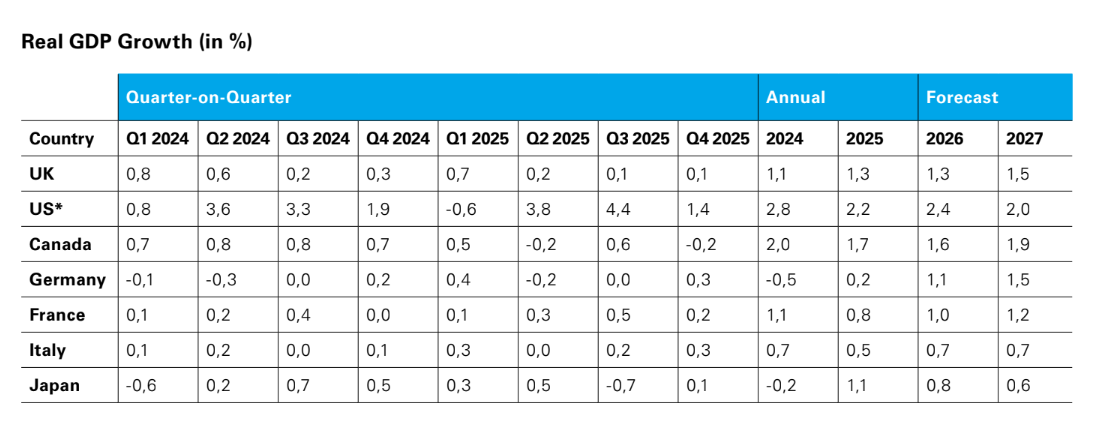
Sources: ONS, BEA, Statistics Canada, OECD, IMF; Notes: Quarterly data for the US are seasonally adjusted annualized rates
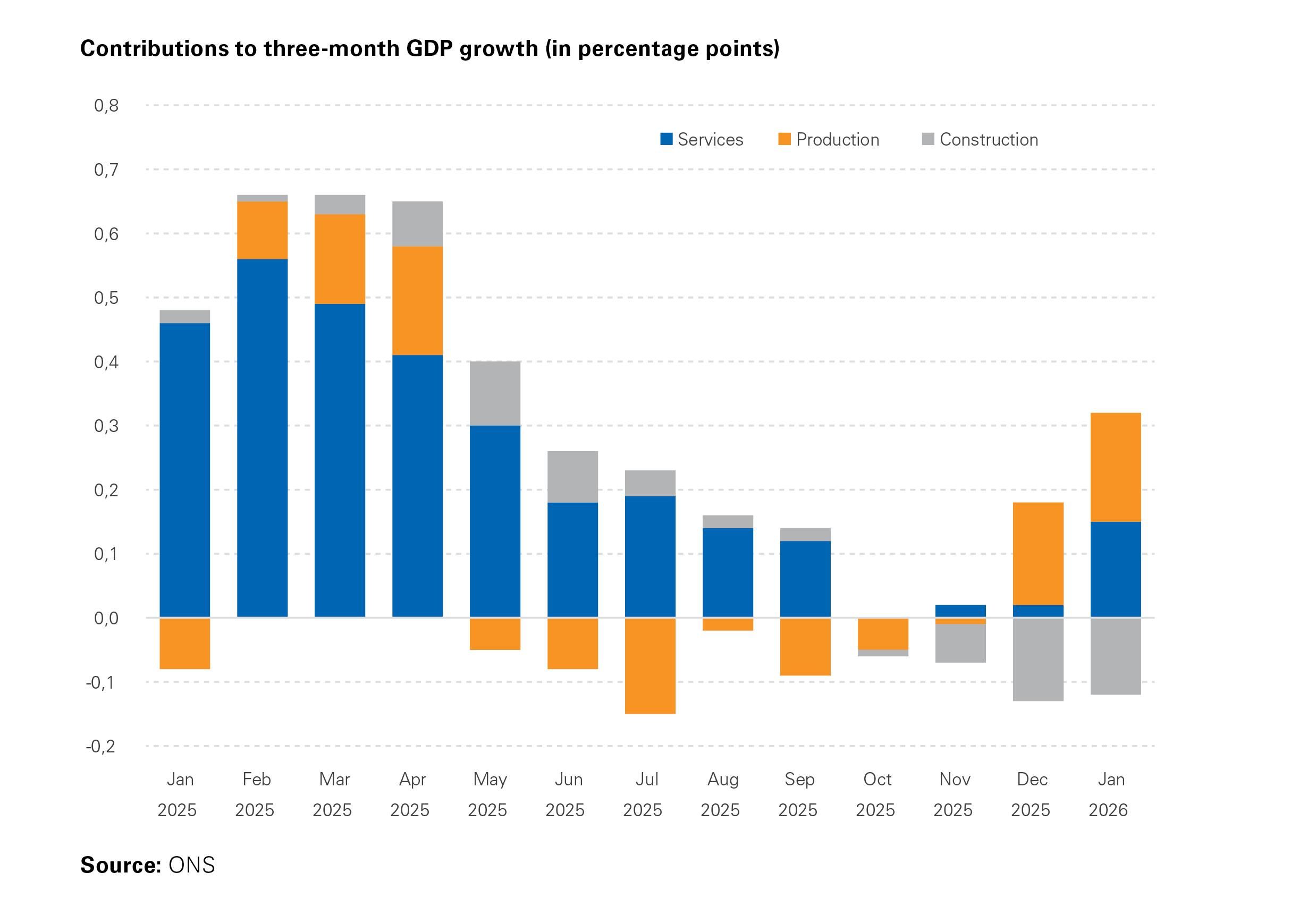
GDP growth in January 2026 offers a tentative sign of stabilisation: the economy was flat on the month but grew 0.2% on the rolling three-month measure to January. In its 3 March Spring Statement2, the OBR cut its forecast for UK GDP growth in 2026 to 1.1%, down from its November projection, citing a loosening labour market and subdued business surveys. It simultaneously revised up its forecasts for 2027 and 2028 to 1.6%3, implying a temporary slowdown before growth recovers. However, the watchdog emphasised that its projections were finalised before the 28 February US-Israeli strikes on Iran and the subsequent disruption in the Strait of Hormuz, warning the conflict “could have significant impacts on the global and UK economies”. Financial markets reacted immediately – the implied probability of a Bank of England rate cut at the March meeting fell from around 80% in late February to roughly 20-30% in early March as gilt yields and swap rates surged amid rising energy prices and geopolitical risk. As a result, forecasts produced before 1 March should be interpreted as pre-conflict baselines rather than current assessments of the growth outlook.
Business confidence remained fragile through early 2026. After a brief improvement at the start of the year, the Institute of Directors’ Economic Confidence Index4 fell back in February, indicating that directors remain deeply pessimistic about the near-term economic outlook. Confidence in firms’ own prospects also weakened sharply, while expectations for revenue, hiring and exports all deteriorated. The escalation of conflict in the Middle East in late February has since introduced a significant new source of uncertainty for businesses across much of the economy.
Source: ONS
Activity data point to a mixed sectoral picture. Services continued to expand though 2025, but momentum slowed noticeably toward the end of the year, with the sector recording little overall growth in Q4 2025. In the three months to January 2026,services output grew by 0.2% - the first positive reading after three consecutive months of flat output. However, services showed no growth in January itself. Survey evidence remains constructive: the Services PMI5 rose to 54.0 in January before easing slightly to 53.9 in February. Employment across the sector has nonetheless continued to decline as firms adjust to higher payroll costs.
Production is the standout performer in the January data. Output grew 1.3% in the three months to January 2026, the largest sectoral contribution to GDP growth over the period, driven by a 1.5% rise in manufacturing – itself led by a 17.5% surge in motor vehicle production as the sector recovered from a cyber incident that had severely disrupted output in autumn 2025. Stripping this out, the underlying manufacturing picture is more modest but still improving: the PMI reached a 17-month high of 51.8 in January and held at 51.7 in February.
Construction remains the weakest part of the economy. Output fell 2.0% in the three months to January 2026, extending a run of consecutive three-month declines, with new work down 3.2% - driven by a 6.3% fall in private housing. January did bring a tentative monthly uptick of 0.2%, the first monthly rise after three consecutive falls. The Construction PMI of 46.4 in January confirms the sector remains in contraction, with the government’s housebuilding ambitions continuing to collide with the reality of high borrowing costs and weak buyer confidence.
Evidence from recent ONS Business Insights and Conditions Surveys (March 2026) highlight the structural pressures facing firms. Economic uncertainty remains the most frequently cited concern affecting turnover, reported by around 31% of businesses, while labour costs are the most commonly cited challenge among larger firms. At the same time, responses suggest a gradual shift in corporate strategy: investment in automation and artificial intelligence is increasingly being used to improve productivity rather than simply as a cyclical response to current cost pressures.
UK consumer confidence has remained stubbornly negative throughout the review period with little sign of a durable recovery. The OECD’s Consumer Confidence Index stood at 99.62 in February 2026, down slightly from 99.77 in January. Although this suggests sentiment has broadly stabilised, following the 2022-23 cost-of-living shock, the index remains marginally below its long-run average. GfK’s UK Consumer Confidence6 survey reinforces the cautious picture: the headline index fell three points, with the Savings Index dropping seven – the sharpest monthly move in the survey and consistent with households becoming more defensive about near-term finances rather than loosening their grip on discretionary spending.
That defensiveness is visible in the hard data. The household saving ratio remains around 2.5 percentage points above its long-run average, having peaked at 12.0% in Q4 20247. The Bank of England’s February 2026 Monetary Policy Report8 notes that while real disposable incomes are expected to continue rising, the freeze in income tax thresholds will limit how much of that feeds through to consumption.
Retail sales tell the same story of underlying weakness punctuated by false dawns. Volumes fell overall in Q4 2025 before bouncing 1.8% in January9, but three-month growth to January was just 0.1%. The Bank of England expects consumption growth to remain weak in the near term, with any meaningful boost dependent on the pace of monetary policy easing as the year progresses.
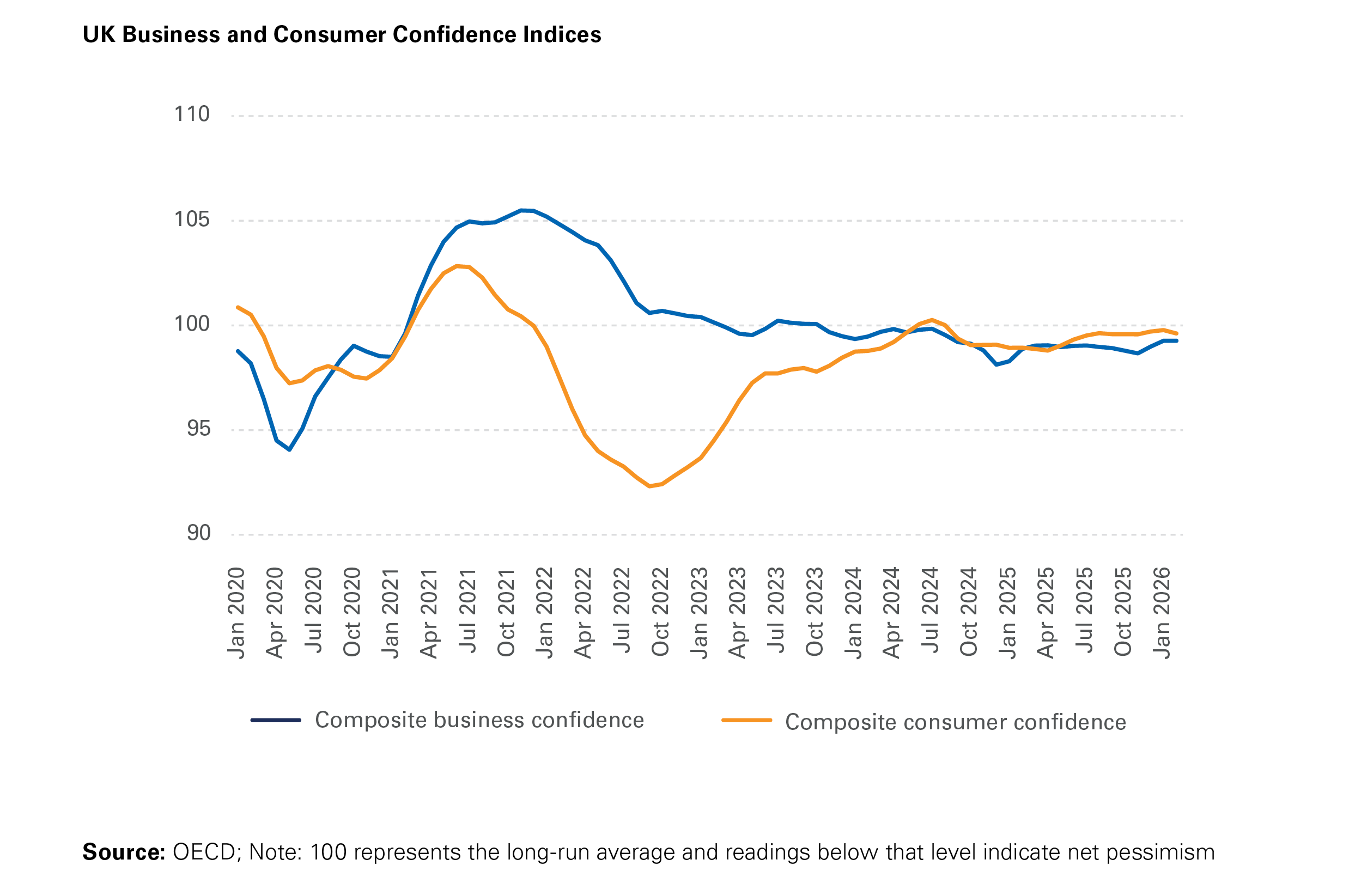
Source: OECD; Note: 100 represents the long-run average and readings below that level indicate net pessimism
Inflation has been on a broadly improving trajectory since its mid-2025 peak, though it remains stubbornly above the Bank of England’s 2% target. CPI inflation stood at
3.0% in January 202610, down from 3.4% in December, indicating that the late-2025 uptick was temporary and has already begun to unwind. The more telling signal lies beneath the headline: core inflation – stripping out energy and food to reveal underlying domestic price pressure – fell to 3.1% in January, its lowest since September 2021. Core inflation remains around a percentage point above the Bank of England’s 2% target, suggesting underlying price pressure persist and helping explain why the February vote to hold rates was closer than markets expected.
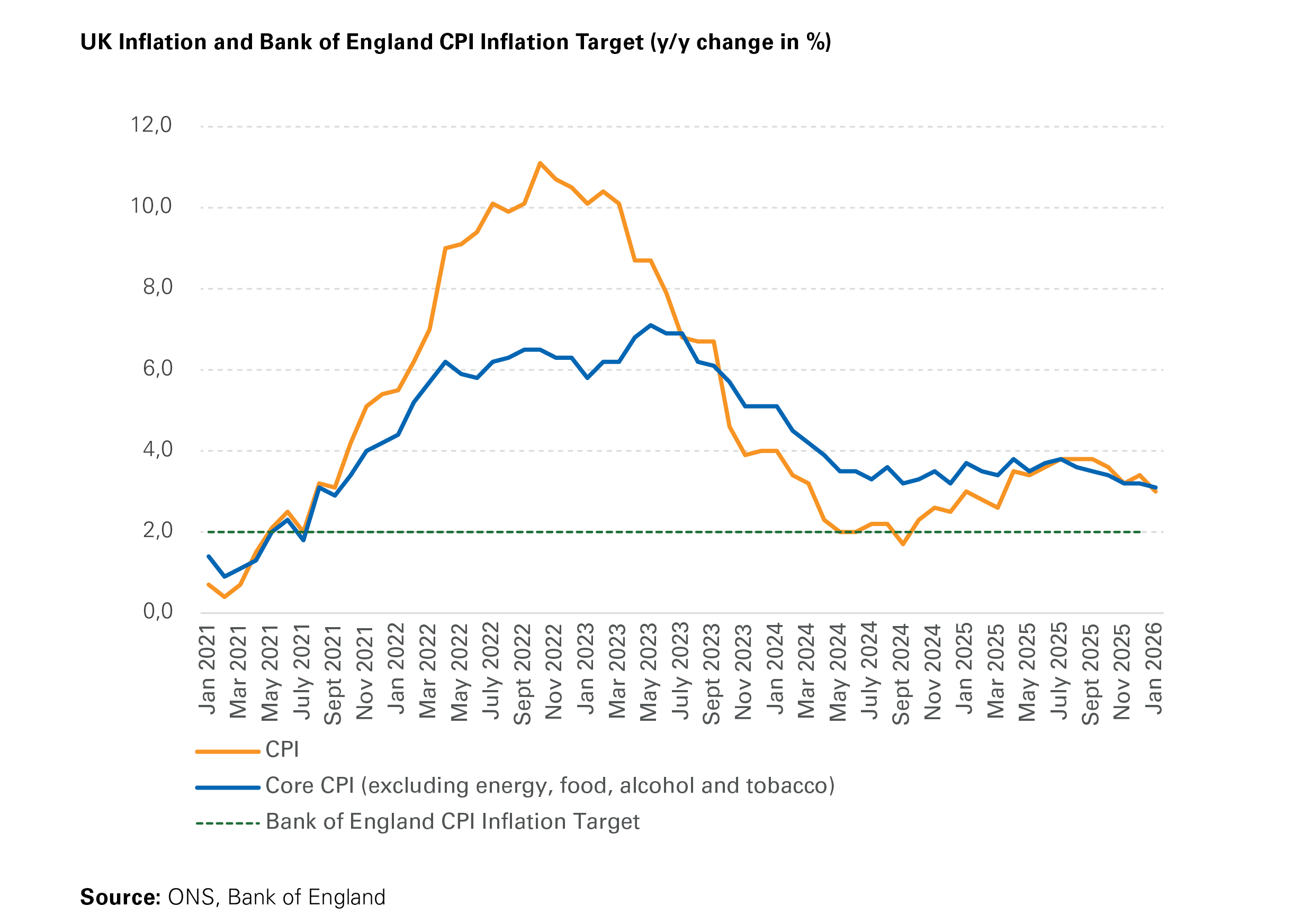
Source: ONS, Bank of England
The disinflation trajectory has been materially complicated by the Iran conflict. The OBR has forecast CPI at 2.3% for 2026, but immediately caveated those projections, warning the conflict “could have significant impacts.” UK natural gas prices11 have almost doubled since the strikes, with the UK particularly exposed given its import reliance and vulnerability to Strait of Hormuz disruption. NIESR12 modelling finds that a transitory shock of this magnitude would add around 0.3 percentage points to UK CPI; a persistent one lasting a year could add 0.7 percentage points and potentially force the Bank of England back above 4%. With the 2022 energy shock still in institutional memory, second-round effects and sticky inflation expectations are a genuine risk if energy prices remain elevated. Duration is the critical variable – and it remains deeply uncertain.
The Bank of England cut Bank Rate six times between August 2024 and December 2025, a cumulative 150 basis points of easing from the 5.25% peak to 3.75%. That loosening has not yet translated into any material improvement in activity, confidence, or credit conditions – and this disconnect explains why the February 2026 MPC vote to hold was a far tighter 5-4 than the 7-2 markets had expected.
The five holding members, led by Governor Bailey, maintained that services inflation and wage growth need to fall further before they can be confident the return to target will stick. The four dissenters – including Deputy Governor Breeden – concluded the weakening labour market and falling wage settlements had already made the case for an immediate cut. The divide reflects a genuine disagreement about the level of the neutral nominal rate, not a straightforward hawkish/dovish split. Most estimates place it between 2.5% and 3.5%, and if it has drifted structurally higher – as some MPC members believe13, partly reflecting AI-driven global capital investment demand – then current rates are closer to neutral than they appear, and further easing carries more inflation risk than the headline figures suggest.
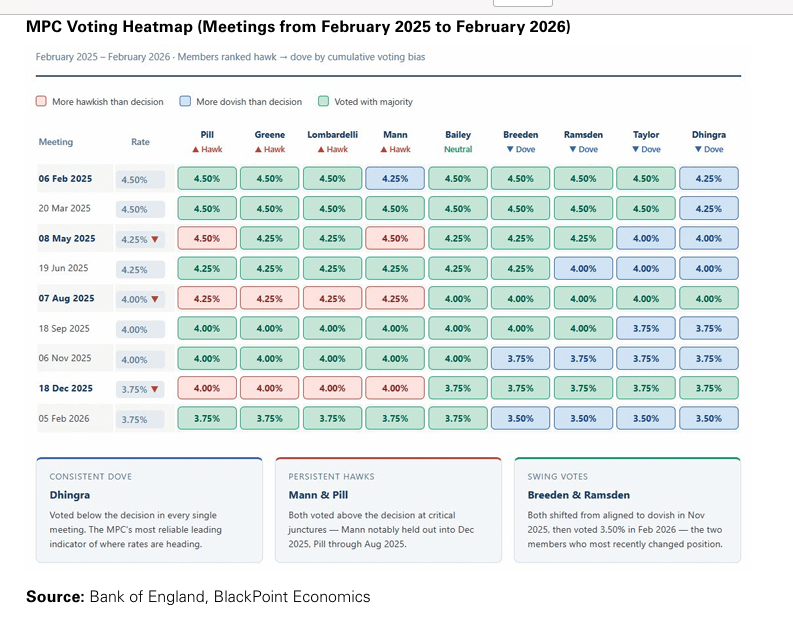
The path from here depends critically on whether services inflation cooperates. The Bank’s own projections have CPI returning to the 2% target in spring 2026, largely reflecting favourable base effects. If realised, this would open the door to rate cuts later in the spring and summer. The May MPC meeting is the most likely occasion for the next move.
The risk is that the second half of 2026 sees services inflation prove stickier than expected, as the April minimum wage increase and public-sector pay settlements feed through to labour costs, potentially making the easing cycle shallower than markets currently price. Upside risks to inflation have come increasingly into focus, particularly from geopolitical developments involving Iran. Any disruption to energy supply or shipping routes – especially through the Strait of Hormuz – could push oil and gas prices higher and delay the disinflation process. The ECB, already at 2.0% after eight cuts, highlights how far the Bank still has to travel, and the roughly 175bp policy gap has kept sterling firm, acting as a quiet drag on export competitiveness.
For credit professionals, the practical implication is straightforward: rate relief in 2026 will be real but gradual. Two to three further cuts – taking Bank Rate to 3.0-3.25% by year-end – would provide meaningful support to rate-sensitive sectors and leveraged balance sheets, but will not resolve the structural demand weakness and margin compression driving credit stress.
The deterioration in UK labour market conditions that was already evident in the September 2025 report has accelerated significantly over the subsequent six months.
The unemployment rate rose to 5.2% in October to December 202514 – up from 4.7% in May 2025 and from 4.4% a year earlier – representing a gain of around 331,000 unemployed people over the twelve months to December 2025. At 1.88 million, this is the highest unemployment level since 2015. Analysis from the Work Foundation at Lancaster University15 suggests the UK has recorded the fastest annual rise in unemployment across the G7.
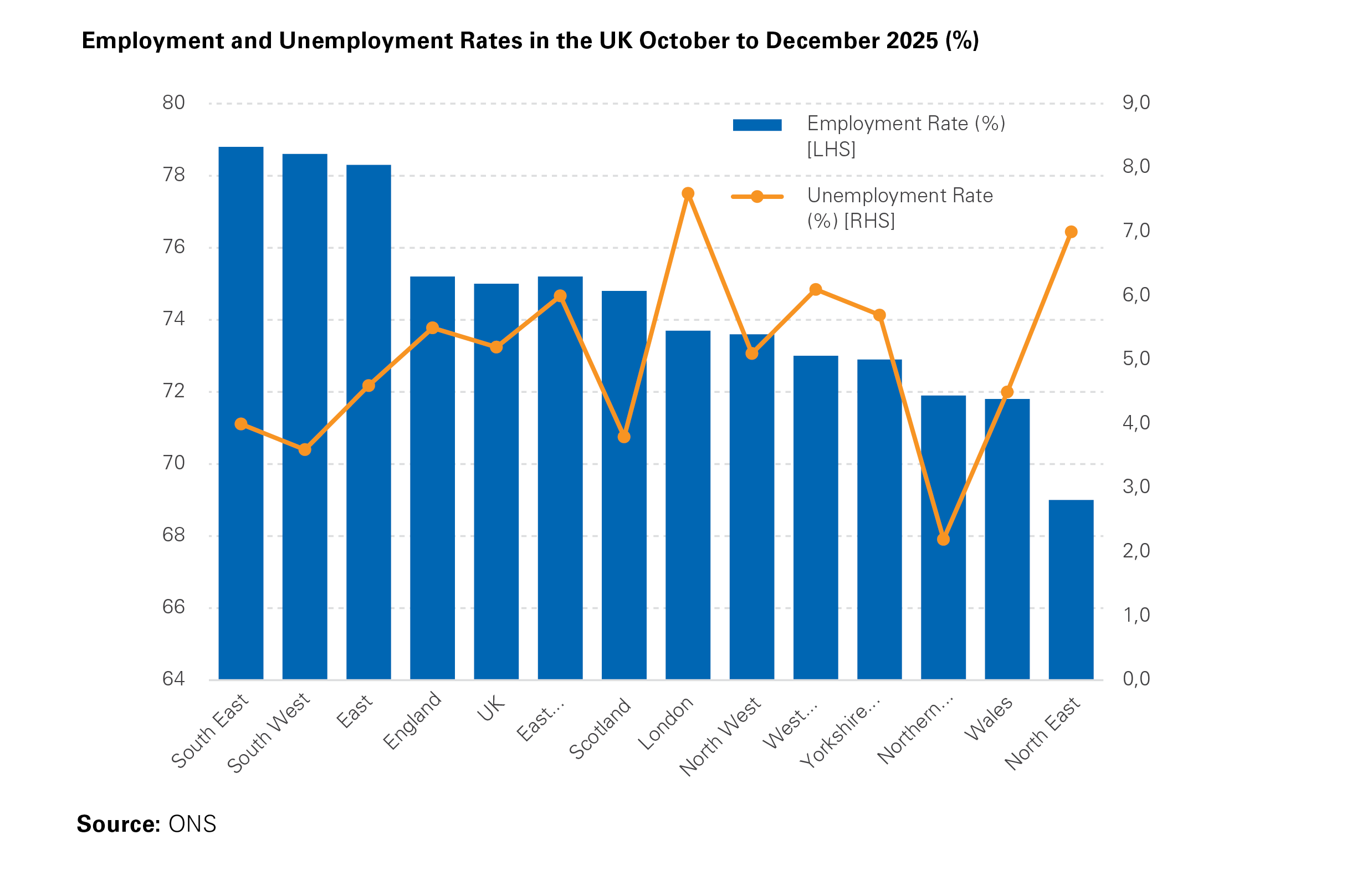
Source: ONS
Youth unemployment has risen particularly sharply. Those aged 16-24 face a headline unemployment rate of 16%16 - the highest in over a decade – with around 739,000 young people out of work, an increase of approximately 100,000 year-on-year. The data is even more pronounced among 16-17-year-olds, where unemployment stands at 34.7%, reflecting pressures at the bottom of the labour market as higher entry-level wage costs and cautious hiring dampen opportunities for younger workers.
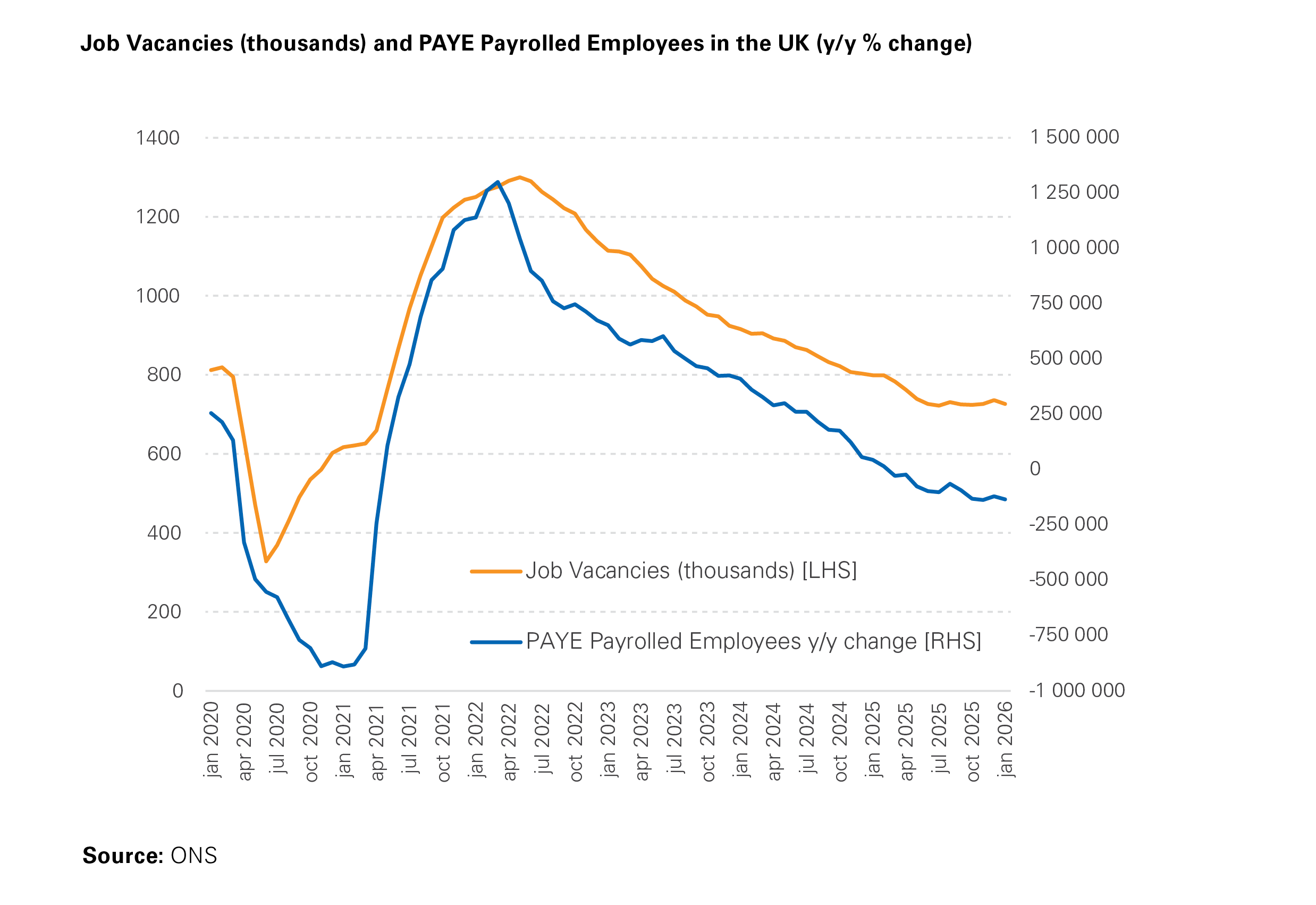
The number of vacancies stood at 726,000 in the three months to January 2026, 73,000 lower than a year earlier and well below the peak of around 1.3m recorded in mid-2022. While vacancies remain far below their post-pandemic highs, the series has stabilised in recent months, suggesting that the sharp adjustment in labour demand may be moderating. Payrolled employment – drawn from the more reliable HMRC PAYE Real Time Information17 data has also softened, with the number of payrolled employees lower on a year-earlier basis, reinforcing signs that hiring momentum has weakened. As labour demand has cooled, competition for available roles has intensified, with roughly 2.6 unemployed people for every vacancy, up markedly from around 1.9 a year earlier.
Wage growth has moderated further. Average earnings18 rose by 4.2% in the three months to December 2025, down sharply from the 8% + rates recorded at the peak in 2023. In real terms, regular pay (excluding bonuses) increased by just 0.8%, indicating only marginal gains in purchasing power. The aggregate figures are somewhat distorted by the public sector, where regular pay growth reached 7.2% y/y, reflecting earlier 2025 pay settlements feeding through to the data.
The April 2025 increase in employer National Insurance contributions from 13.8% to 15% alongside a reduction in the secondary threshold from £9,100 to £5,000 remains the most frequently cited constraint on hiring intentions in business surveys. Combined with the 6.7% rise in the National Living Wage for workers aged 21+, the measure has raised labour costs sharply, prompting firms in hospitality, retail, care and other labour-intensive sectors to cut headcount, freeze hiring and accelerate investment in automation. Further cost pressures are imminent – the National Living Wage will rise by 4.1% in April 2026, while the 18-20 rate will increase by 8.5%19 as the government moves to align youth rates with the adult minimum wage. Business
groups have urged ministers to slow the equalisation timetable, citing concerns about its impact youth unemployment.20
The modest improvement in UK credit risk seen in 2024 has stalled. Business failures have plateaued at structurally elevated levels, payment performance has deteriorated, and the combination of sustained labour cost pressures, subdued demand and still-tight financing conditions means the outlook for H1 2026 remains challenging.
Late payment stress has intensified across the UK corporate sector and shows little sign of easing. In late 2025, 90% of UK companies experienced late payments over the preceding year, with the average delay running to 32 days – roughly a month beyond agreed terms. According to a March blog by QuickBooks21, 61% of UK small businesses were owed money from unpaid invoices, with 51% saying that the delay was sufficient to cause cash flow problems – a working capital drain that is increasingly forcing businesses, particularly smaller ones, onto short-term credit to fund day-to-day operations. The strain is most acute in construction, reflecting its particular exposure to fixed-price legacy contracts and long payment chains. While 37% of companies expect payment delays to decrease in 2026, optimism is unevenly distributed: micro and small businesses remain sceptical, with 66% expecting economic conditions to deteriorate further or stay the same.
The number of registered company insolvencies in England and Wales was 1,744 in January 2026 – 3.6% higher than in December 2025, though 14.0% lower than the same month a year earlier. The year-on-year comparison flatters the picture – the January 2025 was itself an exceptionally high month. The rolling 12-month insolvency rate stood at 51.7 per 10,000 companies in England and Wales as of January 2026 - equivalent to one in every 193 active companies entering insolvency proceedings over the preceding year. That rate has eased from its local peak of 53.4 in October 2025, but remains double the 2019-20 pre-Covid baseline.
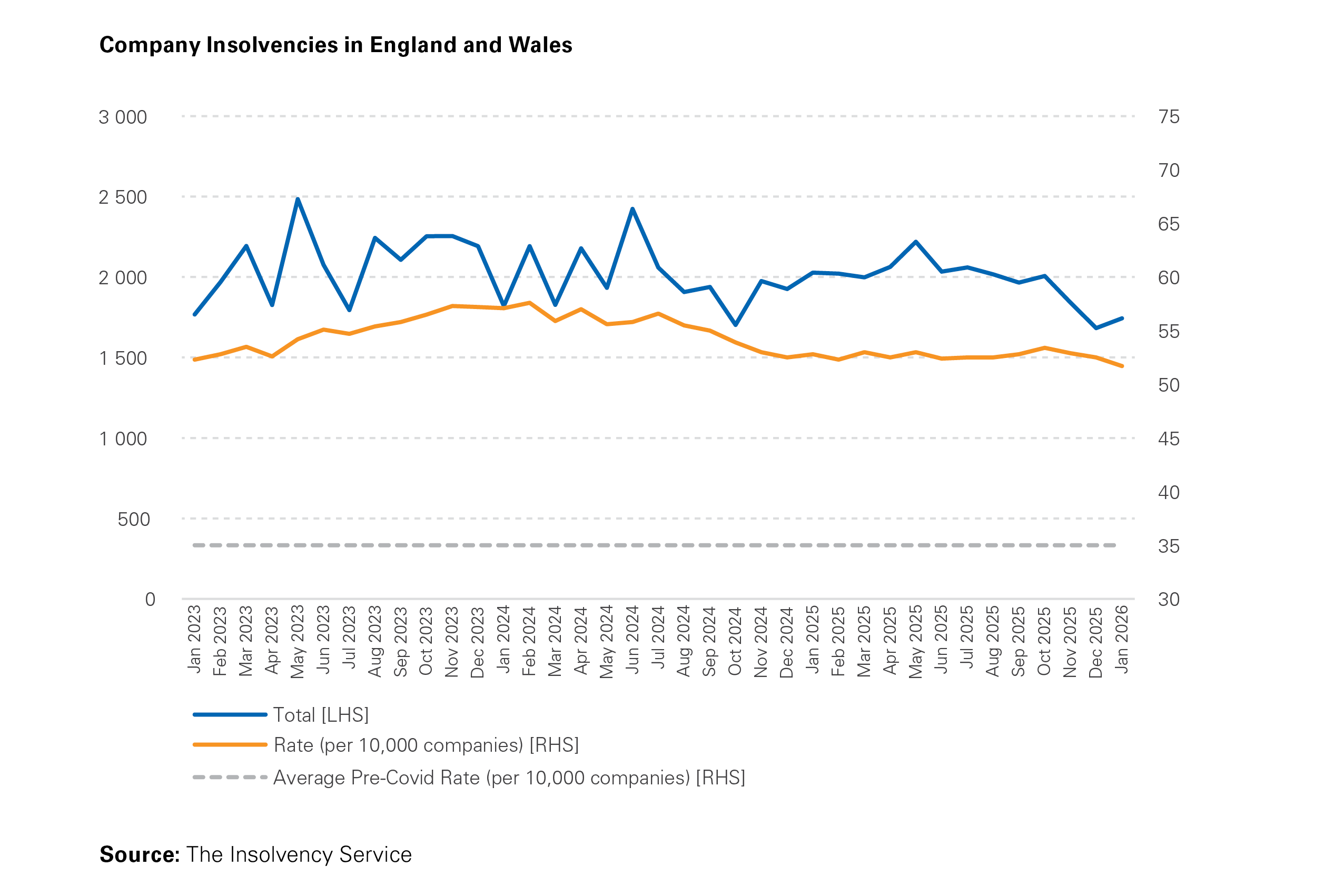
Creditors’ Voluntary Liquidations accounted for 76% of all cases in January 2026 – a consistently high share (through all of 2025 it was 77%) that reflects directors choosing to close businesses under sustained cost and margin pressure rather than being forced into court proceedings. Construction and wholesale and retail trade each accounted for around 16-17% of all insolvencies in the 12 months to December 2025. More broadly, EY-Parthenon23 has noted a more than 40% m/m rise in administration activity across the economy in January 2026, interpreting this as geopolitical and earnings pressure beginning to crystalise into more formal restructuring rather than voluntary wind-down.
At the system level, the Bank of England’s December 2025 Financial Stability Report23 noted that UK household and corporate debt remain low in aggregate and that major banks remain well capitalised. However, the Committee was explicit that overall risks to financial stability increased during 2025, with geopolitical tensions, trade fragmentation and sovereign debt pressures identified as potential amplifiers.
The credit risk environment for H1 2026 is likely to remain challenging. Modest GDP growth, sustained labour cost pressures, constrained consumer spending, and tight lending conditions all point to continued strain on corporate margins, and any rate relief from the Bank of England – should cuts materialise in the spring – will provide support at the margin rather than resolve the underlying demand weakness. One positive signal is that insolvency volumes have now fallen for three consecutive months from their spring and summer 2025 highs, suggesting the most acute phase of the current cycle may be passing.
The broader picture is one of an economy that has stabilised but not recovered: inflation remains above target, real wage gains are marginal, business investment is contracting, and the labour market is loosening faster than the MPC anticipated. The principal near-term variable is energy – if the Iran disruption proves transitory, the path to gradual easing and modest recovery in H2 2026 remains intact. If it persists, the outlook deteriorates materially, and the policy trade-offs facing the Bank of England become significantly harder.
By TMHCC Credit Economic Advisors
References
[2] https://www.gov.uk/government/speeches/spring-forecast-2026-speech
[5] https://www.pmi.spglobal.com/
[6] https://nielseniq.com/global/en/news-center/2026/consumer-confidence-down-three-points-in-february/
[8] https://www.bankofengland.co.uk/monetary-policy-report/2026/february-2026
[9] https://www.ons.gov.uk/businessindustryandtrade/retailindustry/bulletins/retailsales/january2026
[10] https://www.ons.gov.uk/economy/inflationandpriceindices/bulletins/consumerpriceinflation/january2026
[11] https://www.ice.com/products/910/UK-NBP-Natural-Gas-Futures/data?marketId=6164518&span=3
[12] https://niesr.ac.uk/news/middle-east-conflict-macroeconomic-impacts-rising-oil-and-gas-prices
[19] https://www.gov.uk/government/publications/minimum-wage-rates-for-2026
[20] https://www.ft.com/content/594a33bb-9715-418b-bce1-fd2bcec31ff9
[21] https://quickbooks.intuit.com/uk/blog/sme-insights-january-2026/
[22] https://www.ey.com/en_uk/newsroom/2026/02/january-2026-company-insolvency-data-comments
[23] https://www.bankofengland.co.uk/financial-stability-report/2025/december-2025